Compliance
Carbon & Compliance
Emission and penalty calculations with the official EU ETS and FuelEU Maritime formulas. You can always see which noon report each figure comes from.
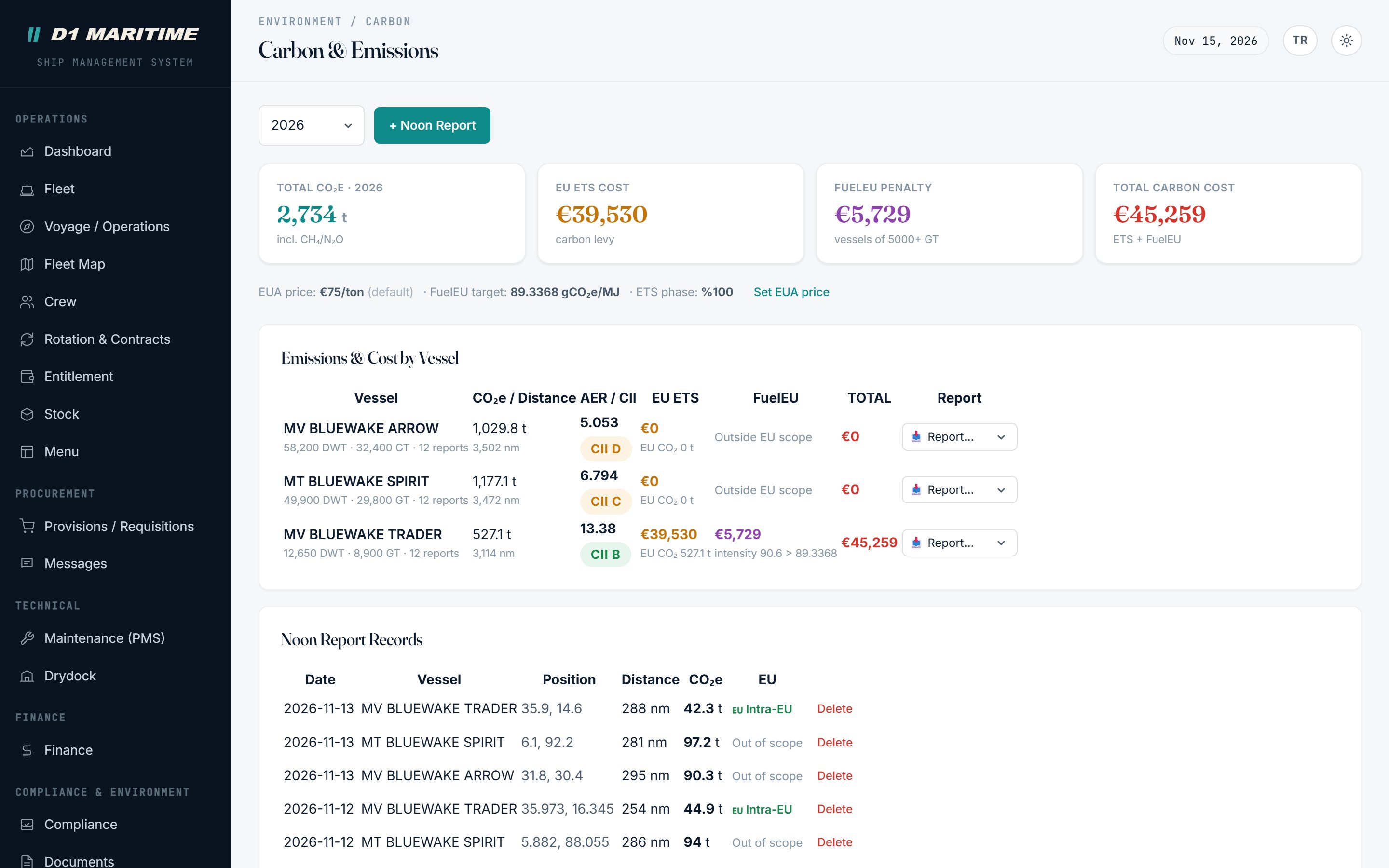
Emission and penalty calculations with the official EU ETS and FuelEU Maritime formulas. You can always see which noon report each figure comes from.
Europe's carbon regulation grows more complex every year. The modules in this family do the calculation, raise the warning and explain what it means.
The carbon cost of voyages within the EU Emissions Trading System is calculated with the official formula. The scope ratio is applied automatically by voyage type (100% intra-EU, 50% inbound/outbound), and the liability estimate updates throughout the period.
The greenhouse gas intensity of the fuel used is compared against the target that changes year on year. When the target is exceeded, the resulting penalty is estimated in advance — you can act before the period closes.
The daily voyage report: position, distance covered, average speed, machinery running hours, weather and sea state, and fuel consumption. It is the data source behind every carbon calculation.
HFO, VLSFO, MGO, LNG and alternative fuels tracked by type. Bunker intakes and consumption records are converted to CO₂ equivalent using emission factors.
Per-vessel and fleet-level emission reports. The annual carbon intensity rating (CII, A-E) is calculated and a low rating is flagged in advance; ready-made output is produced for MRV/DCS submissions.
Vessel certificates, class documents, insurance and compliance papers with their validity dates in one list. Which document expires on which vessel and when, all on one screen.
Document status from the crew records is also monitored from a compliance angle. Before an inspection, the answer to "is anything missing on board?" is ready and waiting.
Warranted speed and consumption are compared with actuals; bad-weather days are excluded and laden and ballast legs are checked against their own warranties. The result is an indicator, not a claim calculation.
Certificate validities, report submission dates and notification deadlines raise an alert before they lapse. The alert threshold is configurable by document type.
A daily noon report becomes a liability and a recommendation by period end.
EU ETS, FuelEU, MRV... Europe's carbon regulation grows more complex every year. D1 Maritime does the calculation with the official formulas and shows where each figure comes from.
The carbon calculation is fed by the rest of the operation — it is not a separate spreadsheet.
The estimated EU ETS liability is reflected in the budget as a cost line, so there is no surprise payment.
← CrewCrew certificates are also monitored on the compliance dashboard; the list of missing documents is ready before an inspection.
← PMSMachinery running hours and maintenance status are taken into account in fuel efficiency interpretation.
Yes. EU ETS and FuelEU Maritime calculations use the official formulas in force; when the regulation is updated, the formulas are updated too. Results are reported at a level of detail you can present to an audit.
The noon report is the primary data source for the carbon calculation. Missing days are flagged on the dashboard and the calculation is shown with an "incomplete data" warning; an estimate can still be made, but an official submission requires the report to be complete.
The trend is tracked and you are warned as your rating approaches D/E. The breakdown by vessel and voyage shows which profile is pulling the rating down.
Yes. Per-vessel and fleet-level emission reports are exported in a submission-ready format, preserving the level of detail a verifier requires.
You are currently in one solution family. Here is the whole of D1 Maritime — all sharing one data model.
Let us show you how this solution family works on your fleet in a tailored demo.