Safety
HSEQ & Safety
From incident to root cause, from risk matrix to permit to work, from audit to vetting preparation — the safety management system the ISM Code expects, straight out of the box.
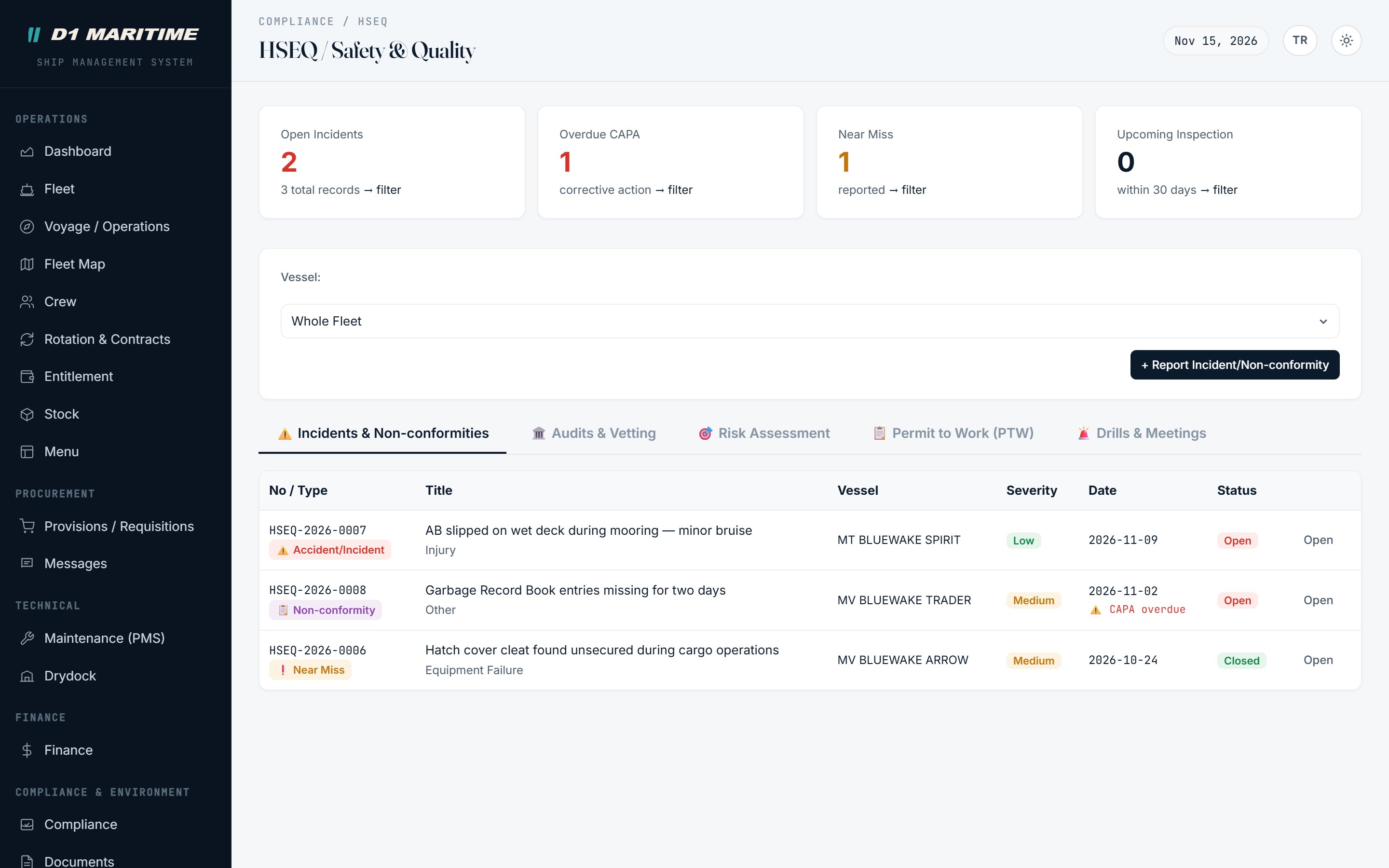
From incident to root cause, from risk matrix to permit to work, from audit to vetting preparation — the safety management system the ISM Code expects, straight out of the box.
The safety management system the ISM (International Safety Management) Code expects arrives assembled, component by component — not a form bolted on later, but a natural part of the system.
Accidents, near misses, non-conformities and observations are held in one structure: date, place, people involved, photos, narrative and immediate action. Reports can be raised from the vessel on mobile.
The 5-whys method drives down to the real cause; root cause, corrective action, owner and deadline are tied to the record.
Corrective and preventive actions are tracked with an owner, a due date and closure evidence. An open CAPA stays red on the dashboard; at audit, the answer to "was it followed up?" is ready.
The risk score is calculated as likelihood × severity. As control measures are entered the residual risk is recalculated; every assessment is dated and attributed to a responsible person.
A visual 5×5 matrix. The position before and after controls is compared on the same screen — whether the measure actually worked is visible at a glance.
Hot work, enclosed space entry, working aloft, electrical isolation, diving and overside work. Each permit type has its own checklist, gas measurement fields and time limit.
Approval is by the authorised person for the permit type. Nobody can approve a permit they raised themselves — dual control is mandatory. An unapproved permit is not valid and stays open in the record.
ISM internal audits and external audits are planned and carried out. Findings are recorded with their non-conformity level (major/minor/observation) and linked to CAPAs until closed.
Port state control records, findings and detention risk. Past inspections stay on the vessel card, so you know what to watch at the next port.
Tanker vetting preparation, observation management and closure tracking. The preparation list for the next vetting is derived automatically from past findings.
Every incident logged leaves a trace in the system until it is closed.
A missed CAPA, an unclosed non-conformity, a missing permit to work — any of these can lead all the way to detention. D1 Maritime keeps the entire safety process on record.
Safety touches every part of the operation — from maintenance to crew, from permits to cost.
If equipment failure or overdue maintenance is the root cause of an incident, the CAPA can be linked directly to a maintenance job.
← CrewPermit approvals, CAPA ownership and incident reporting all run off the role and certificates in the crew record.
↔ DrydockHot work and enclosed space jobs during the drydock period are managed with the same PTW structure; no job goes unrecorded.
Yes. Incident types, non-conformity levels, risk matrix thresholds and permit checklists are configured to your own safety management system. The system arrives with a ready ISM skeleton and your procedures sit on top of it.
Yes. The permit is raised on board, the checklist and gas measurements are entered, and work begins once the authorised approval arrives. The approval chain does not let you approve your own permit.
With the 5-whys method. Every incident gets a root cause, corrective action (CAPA), owner and deadline; overdue CAPAs show on the dashboard and in the compliance score.
Past findings accumulate on the vessel card; the system surfaces recurring themes and produces a preparation list for the next inspection. Open CAPAs and expiring documents appear on the same screen.
You are currently in one solution family. Here is the whole of D1 Maritime — all sharing one data model.
Let us show you how this solution family works on your fleet in a tailored demo.